

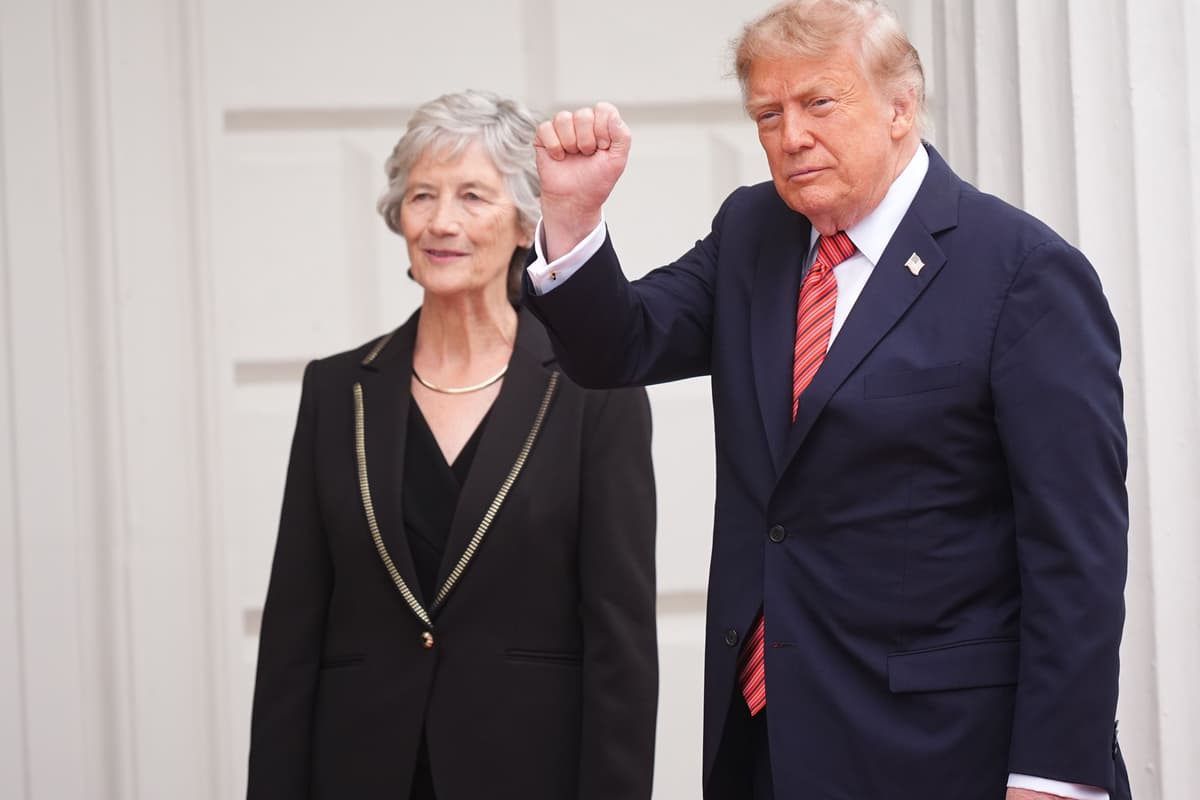
US president says he would “love” to see Ireland reunified, while Britain insists Northern Ireland’s future must be decided under the Good Friday Agreement.
DUBLIN: US President Donald Trump said he would welcome a united Ireland during his visit to Dublin on Saturday, calling reunification a “fantastic thing” and suggesting it would eventually happen.
Speaking alongside Irish Prime Minister Micheál Martin at Farmleigh House, Trump said he believed Martin was the “right man” to help advance the issue.
“I think it would be a great thing. How can it be bad?” Trump said, while acknowledging that the United Kingdom would have a say in the matter.
The comments represent a departure from the traditional US position of neutrality on Northern Ireland’s constitutional future and immediately drew attention in Britain and Ireland.
Martin’s spokesperson said Trump’s position was not unexpected, arguing that the US president had consistently viewed Irish unity as the preferred outcome.
The British government, however, reiterated its commitment to the 1998 Good Friday Agreement, which provides the framework for Northern Ireland’s constitutional arrangements.
Prime Minister Andy Burnham told Parliament earlier in the week that any decision to hold a referendum on Northern Ireland’s status rested with the Northern Ireland secretary. He said a poll should be considered only if evidence suggested that a majority would support reunification, adding that such a vote was currently “off the table.”
Under the Good Friday Agreement, the British government is required to call a referendum if it appears likely that a majority in Northern Ireland would vote to leave the United Kingdom and join the Republic of Ireland.
Trump’s remarks were welcomed by Sinn Féin leader Mary Lou McDonald, who urged Martin to begin preparations for Irish reunification.
The Democratic Unionist Party took the opposite position. Its leader, Gavin Robinson, said Northern Ireland’s constitutional future should be determined by its people rather than by political statements from Washington, London or Dublin.
Trump’s comments came during a two-day visit to Ireland. Earlier, he met Irish President Catherine Connolly at Áras an Uachtaráin, the presidential residence, before travelling to County Clare to attend the Amgen Irish Open golf tournament.
The visit also drew protests, with more than 10,000 people reportedly marching through Dublin to demonstrate against the US president.
Trump’s intervention adds a new dimension to the long-running debate over Northern Ireland’s constitutional future, placing renewed attention on Irish unity and the political sensitivities surrounding any potential border poll.

