


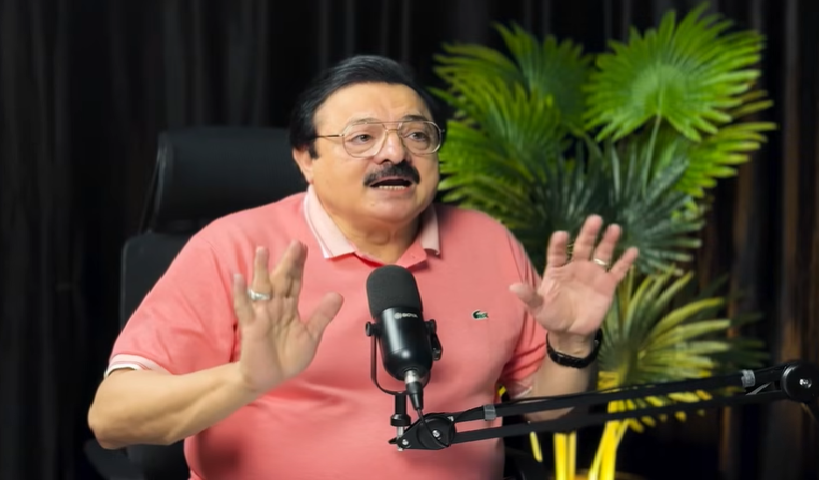
LAHORE: Veteran Pakistani actor, writer and director Syed Mohsin Raza Gilani has spoken candidly about the changing face of Pakistan’s entertainment industry, declining professionalism and the struggles faced by senior artists, saying that respect remains the foundation of genuine love and relationships.
Speaking on the podcast “Voice of Click Me Pakistan,” hosted by Feroz Chaudhry, Gilani reflected on his decades-long career and the difficult journey that took him from radio and theatre in Multan to Pakistan’s television industry.
“If respect disappears from love, love ends,” Gilani said, emphasising that genuine love cannot exist without respect and care.
Gilani, who was awarded the Pride of Performance in 2012, said he considered writing and direction among his strongest abilities. He described writing as an art based on observing society and its characters rather than simply reproducing existing stories.
Recalling the early years of his career, Gilani said he arrived in Lahore in his early 20s after establishing himself in radio and theatre. He recalled facing severe financial difficulties, including travelling on foot when he could not afford petrol and spending time at shrines and relying on free meals during particularly difficult periods.
He said the golden era of Pakistan Television was fundamentally different from today’s entertainment environment. According to Gilani, actors once spent several days rehearsing before appearing before cameras, while discipline and artistic preparation were considered essential.
He criticised what he described as the growing culture of shortcuts, saying that social media popularity has blurred the distinction between online fame and professional acting. He argued that some individuals now consider themselves actors after gaining popularity on platforms such as TikTok and Instagram.
Gilani also criticised the growing influence of marketing and ratings on television drama. He said many contemporary productions repeatedly rely on romance, marital conflicts and dramatic twists because audiences have become accustomed to such formulas.
At the same time, he acknowledged that viewers play an important role in determining what channels produce. He pointed to successful dramas such as “Mere Paas Tum Ho” and “Alif” as examples of productions that demonstrated the continuing potential for quality storytelling.
Discussing the shift of Pakistan’s entertainment industry from Lahore to Karachi, Gilani attributed the movement partly to a lack of professionalism, including delayed payments and poor discipline on production sets. He said Karachi’s industry developed a more organised working environment, particularly regarding schedules and payments.
The veteran actor also highlighted the financial difficulties faced by senior artists, saying many performers have to repeatedly demand payment for work they have already completed.
Commenting on reports surrounding veteran actor Firdous Jamal and his family, Gilani expressed sadness over the situation while stressing that he respected Jamal primarily for his contribution as an actor. He praised Jamal’s performances and said personal matters between an individual and God should not be judged by outsiders.
Gilani also paid tribute to the late actor and director Abid Ali, crediting him with encouraging him to leave the comfort of Multan and establish himself in Lahore.
Reflecting on the industry and society more broadly, Gilani argued that artists who have devoted their lives to Pakistan’s entertainment sector deserve dignity and respect, particularly in their later years.
His comments offered a rare and deeply personal account of the struggles, transformations and challenges confronting Pakistan’s showbiz industry.

